# Favorites

To access your most used dashboards or releases more easily, we've added the possibility to mark these elements as your personal favorites.

### Adding and viewing favorites

#### Dashboards

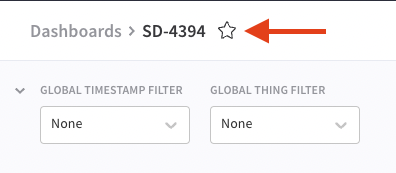
To mark a dashboard as a favorite, simply navigate to the dashboard of your choice, and click on the star icon next to the dashboard name in the top bar.&#x20;

<figure><img src="/files/ZBJmtcPiZxUhNkpS7GWH" alt=""><figcaption><p>Favorite icon next to the dashboard name</p></figcaption></figure>

After clicking the star, this dashboard will be added as a favorite, also indicated by the star turning yellow.&#x20;

You might have also noticed, that your newly added dashboard favorite is now displayed in the main menu sidebar under the "Apps" section, where all of your dashboard favorites will be displayed.

<figure><img src="/files/ME1MlZcP36OE3RhsmJLn" alt=""><figcaption><p>Newly added dashboard favorite displayed in main menu</p></figcaption></figure>

#### Releases

To mark a release as a favorite, find the desired release on the releases overview page, and click Add Favorite in the three-dot menu.

Same as for dashboards, after clicking the star, this release will be added as a favorite, also indicated by the star turning yellow in the three-dot menu.

A newly added release favorite is now displayed in the main menu sidebar under the "Apps" section. To differentiate more easily from dashboard favorites, release favorites have different icons in the main menu (flag).

<figure><img src="/files/fmtnSNVHrv3KfLWzRe5j" alt=""><figcaption><p>Newly added release favorite displayed in the main menu</p></figcaption></figure>

{% hint style="info" %}
Unlike working version dashboards, the frozen dashboard does not have a star icon to Add/Remove favorites.
{% endhint %}

#### General

{% hint style="info" %}
A newly added element will always be added to the top of your favorite list
{% endhint %}

From now on, you can just click on any of the element favorites in the main menu and will be navigated right to that dashboard or release.

{% hint style="info" %}
Users clicking on a release favorite in the main menu will always land on an active version dashboard of that release.
{% endhint %}

To not clutter the main menu sidebar, we by default only show five of your element favorites. To toggle between showing only five favorites and all of your favorites, simply click the button below your element favorites saying either "**Show all favorites**" or "**Show only top 5 favorites**".

<figure><img src="/files/uCvgkBQcG6w5voM5LJPm" alt=""><figcaption><p>Toggling between showing only five favorites and showing all favorites</p></figcaption></figure>

### Removing a favorite

#### Dashboards

To remove a dashboard favorite, simply navigate to the dashboard you want to remove as a favorite and click on the star icon in the top bar next to the dashboard name. The star should then turn white, and the dashboard entry in the favorites section of the main menu should be removed.

#### Releases

To remove a release favorite, go to releases overview page, find the desired release to remove as favorite, and click Remove Favorite in the three-dot menu. The star icon then will turn white and the release entry in the favorites section will be removed.

### Ordering favorites

To move on of your favorites to a different position of your favorites list, simply click on the favorite you want to move and hold your click to start dragging. Afterwards, you can just the favorite to whatever position you prefer and release your mouse.&#x20;

<figure><img src="/files/i32kS4AQ2FRewFL5X67d" alt=""><figcaption><p>Reordering of favorites</p></figcaption></figure>


---

# Agent Instructions: Querying This Documentation

If you need additional information that is not directly available in this page, you can query the documentation dynamically by asking a question.

Perform an HTTP GET request on the current page URL with the `ask` query parameter:

```
GET https://manual.senseforce.io/manual/sf-platform/dashboards/favorites.md?ask=<question>
```

The question should be specific, self-contained, and written in natural language.
The response will contain a direct answer to the question and relevant excerpts and sources from the documentation.

Use this mechanism when the answer is not explicitly present in the current page, you need clarification or additional context, or you want to retrieve related documentation sections.
